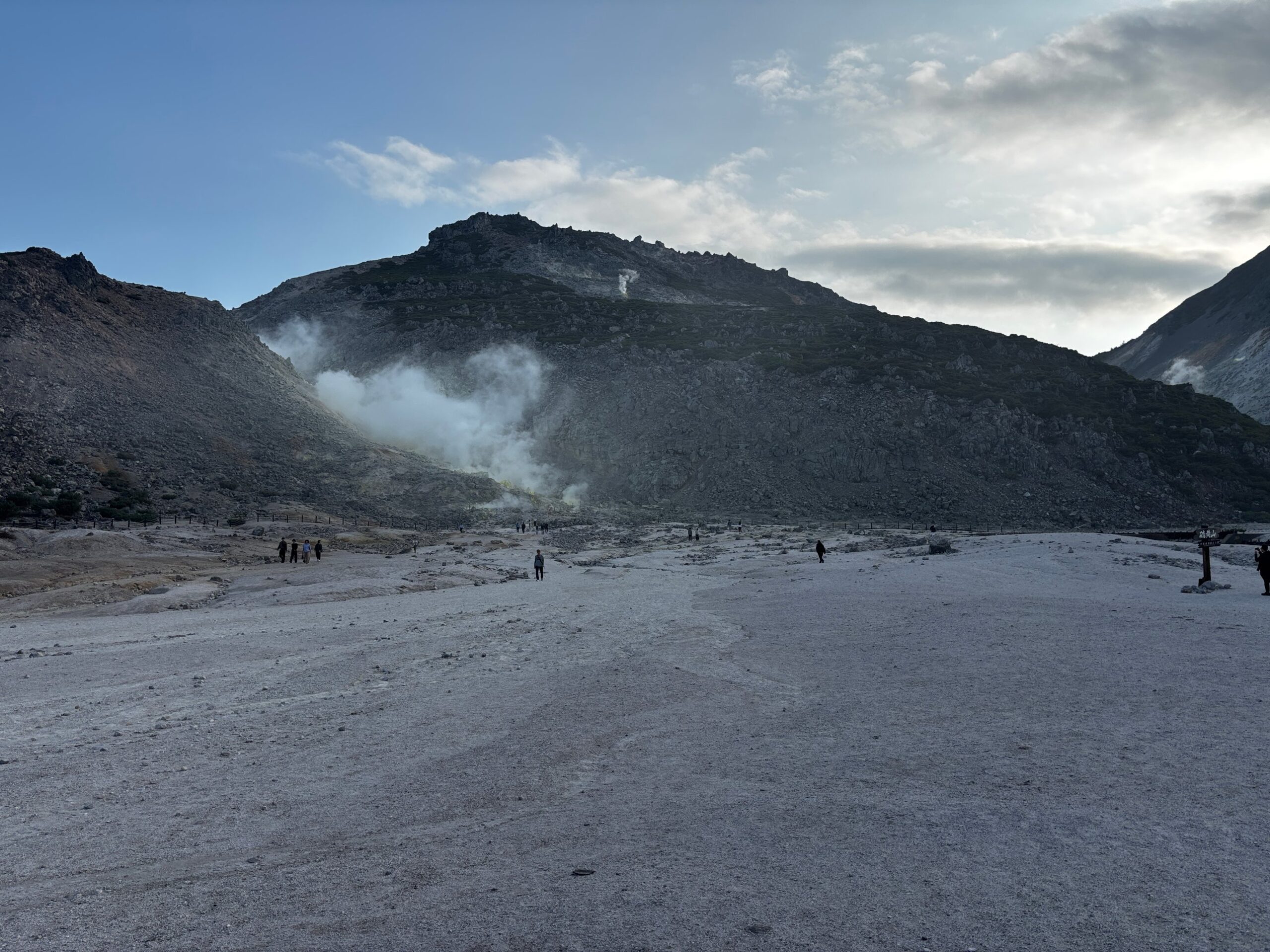
On winter mornings, when it drops below minus 20°C, the moisture in the air freezes into glittering “diamond dust”. Kawayu Onsen in eastern Hokkaido sits in this harsh but beautiful landscape. Just south of town, the still-active Mt. Iozan sends up steam, and a steaming hot spring river runs right through the town.
In September 2026 I made a day trip to Kawayu Onsen. In this guide I share how the bath felt, and also cover the strongly acidic water, the history, where to stay, Mt. Iozan, Lake Kussharo and Lake Mashu, food, how to get there, and practical tips for visitors with tattoos or dietary restrictions.
My visit
I bathed at KKR Kawayu, which accepts day-trip visitors. The banner at the entrance says it is an inn with its own hot spring source, flowing directly into the baths.
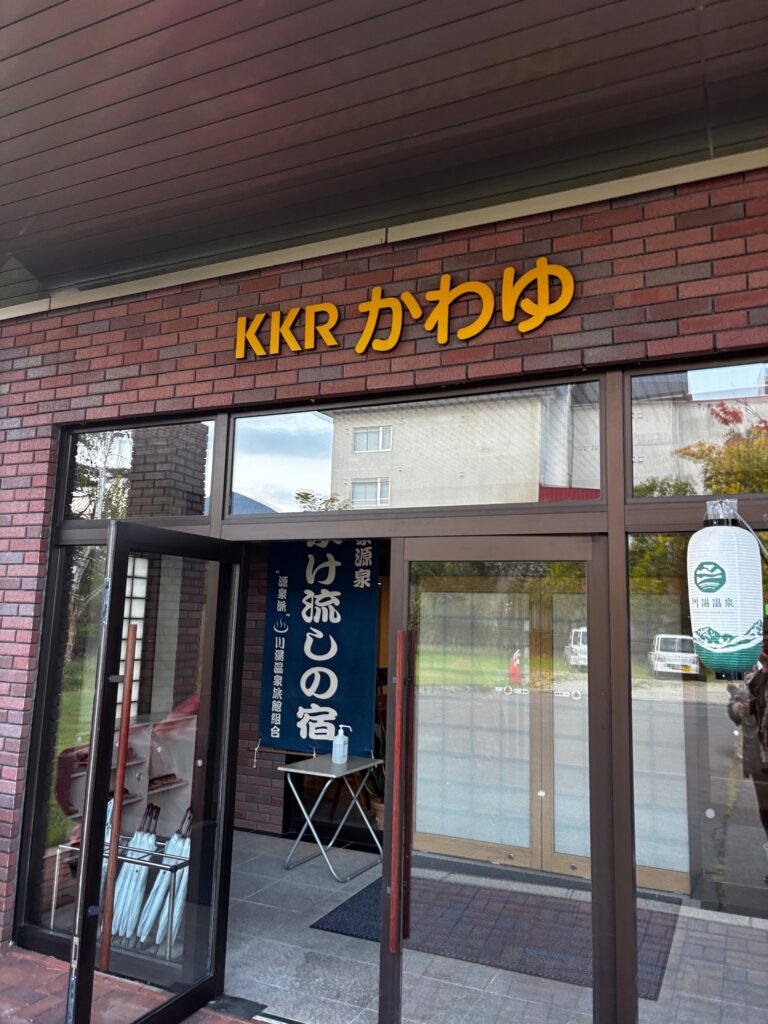
The water felt clean and light, but after I got out I did not cool down at all. I stayed warm and toasty for a long time.
Mt. Iozan is right nearby, and the landscape there looks like a scene from hell. The souvenir facilities are well stocked too, and they were selling hot-spring eggs.
Kawayu Onsen at a glance
| Address | Kawayu Onsen, Teshikaga, Kawakami District, Hokkaido (北海道川上郡弟子屈町川湯温泉) |
| Location | Inside Akan-Mashu National Park, east of Lake Kussharo and west of Lake Mashu |
| Spring type | Acidic sulfur springs and others (most inns have their own source, so the exact names vary slightly) |
| pH | About 1.6–1.9 (strongly acidic) |
| Source temperature | About 44–55°C |
| Inns | 7, plus 1 public bath (according to a guidebook) |
| Nearest station | JR Senmo Line Kawayu Onsen Station (about 10 minutes by bus) |
| Contact | Lake Mashu Tourism Association 015-482-2200 |
Map: Open “Kawayu Onsen footbath” in Google Maps
The water: strongly acidic, like Kusatsu
Kawayu’s bath water is spring water heated by Mt. Iozan, an active volcano about 2.5 km south of town, and pumped up from underground. With a pH of about 1.6–1.9 it is strongly acidic, and it is rich in sulfur and hydrogen sulfide. It is known as a strongly acidic sulfur spring like the famous Kusatsu Onsen in Gunma. The water is clear and colorless, with a strong sour taste.
Antibacterial and good for the skin
The acidic water has antibacterial properties and is said to help skin conditions such as eczema. It is also called a “bath of beauty” because it dissolves old skin cells and leaves your skin smooth. Scientific studies have also shown that warming up in hot spring water lowers blood pressure.
Officially recognized benefits (Ministry of the Environment)
- Acidic spring: atopic dermatitis, psoriasis vulgaris, impaired glucose tolerance (diabetes), skin infections (pyoderma)
- Sulfur spring: atopic dermatitis, psoriasis vulgaris, chronic eczema, skin infections (plus poor peripheral circulation for the hydrogen sulfide type)
- Common to all therapeutic springs: chronic muscle and joint pain, sensitivity to cold, recovery from fatigue, general health, and more
Acidic and sulfur springs can irritate people with sensitive skin or mucous membranes, and older people with dry skin (these are listed as contraindications under the Ministry of the Environment standards).
History: from a sulfur mountain to a hot spring town
- 1877: sulfur mining begins on Mt. Iozan, and settlements are built for the workers
- Around 1898: Asano Kiyoji from Niigata opens the first officially permitted inn, and the hot spring town begins
- 1934: Akan National Park (now Akan-Mashu National Park) is established, and the town grows as a tourist destination
- Postwar to the 1970s: many inns are built and visitor numbers rise sharply
- 2025: a national plan is approved to redevelop the town around its hot spring river, removing abandoned buildings and building new, high-quality inns
Day-trip bathing and free footbaths
Day-trip bathing at KKR Kawayu
| Hours | 13:00–20:00 |
| Price | Adults 700 yen / children 400 yen |
| Spring type | Acidic, iron, carbon dioxide and sulfur-containing sodium sulfate-chloride spring (straight from the source) |
| Address | 1-2-15 Kawayu Onsen, Teshikaga, Hokkaido |
| Phone | 015-483-2643 |
This is from a hot spring information site. Day-trip bathing may not be available when large groups are staying, so call before you go.
Kawayu Onsen Footbath, hand bath and drinking fountain
In the town center, a few minutes’ walk from the Kawayu Eco-museum Center, there is a free footbath fed directly by the hot spring. Nearby you will find a hand bath and a fountain where you can taste the spring water. In winter, steam rises against the snow and ice, and the scene is beautiful.
Kawayu Shrine, next to the footbath, has one of Japan’s only hot-spring-fed “temizuya” (purification basins).
Where to stay
Most inns at Kawayu have their own source and let the water flow straight into the baths. Here are options I could confirm from official and travel agency information.
KKR Kawayu (an affordable public inn)
The inn where I took my day-trip bath. A public inn with 100% straight-from-the-source baths and meals made with local ingredients. Stays are listed from 8,650 yen per night. If you come by car from November to April, the inn says winter tires or chains are a must.
Kawayu Kanko Hotel (baths at three temperatures)
Its water flows straight from the source with no added water and no recirculation. The baths are set to high, medium and low temperatures, and the low-temperature bath at about 38°C is perfect for a long soak. Dinner is a local-food buffet, and you can drink Lake Mashu’s underground spring water for free at the café next to the front desk.
Oyado Kinkiyu Bettei Suikazura (a calm inn)
Formerly the Kawayu Daiichi Hotel Suikazura. Known for its 100% natural hot spring water flowing straight from the source.
Note: its sister inn “Oyado Kinkiyu” is listed as temporarily closed. Check before you book.
Sights
Mt. Iozan (Atosanupuri)
An active volcano called “Atosanupuri” (“naked mountain”) in the Ainu language. Steam rises from bright yellow vents, and the air smells strongly of sulfur. Sulfur mining here once supported the growth of Kawayu Onsen.
- At the “Iozan Rest House” next to the parking lot you can buy the famous hot-spring eggs made with Kawayu’s spring water. Part of the fun is wrapping the shell in tape to crack it (8:00–17:30)
- The parking ticket is shared with Lake Mashu Observatory No. 1 (500 yen for a car, charged from early April to around November)
- The “Tsutsujigahara Nature Trail” runs about 2 km from Kawayu Onsen to Mt. Iozan; in June and July it is covered in Labrador tea flowers (about 1 hour one way)
Kawayu Eco-museum Center
A free center where you can learn about Kawayu’s nature and history through photos and videos. It has a lounge with a fireplace (April–October 8:00–17:00, November–March 9:00–16:00).
Lake Kussharo and Sunayu
At “Sunayu” on the shore of Lake Kussharo, Japan’s largest caldera lake, hot water comes up when you dig into the sand, so you can make your own footbath. It is free and open 24 hours, about 15 minutes by car from Kawayu Onsen Station. There is also “Ike-no-Yu”, a huge outdoor bath 15 m across.
Lake Mashu
A caldera lake known for some of the clearest water in the world. From Observatory No. 1 you can see Kamuishu Island floating on the deep blue lake and Mt. Mashu behind it. The lake is often covered in fog, and on early mornings from June to October you may see a sea of clouds.
Food
Teshikaga is full of good food: “Mashu soba” noodles, “Mashu wagyu” beef, mangoes and strawberries grown with hot spring heat, plus local milk and wine. Do not miss the hot-spring eggs at Mt. Iozan. In the Mashu area of town, “Mashuko no Aisu” is known for its “Mashu Blue” gelato inspired by the color of the lake.
For vegan and vegetarian travelers
As far as I could find, no shop in Kawayu advertises vegan options. Soba may look vegetable-only, but the dipping sauce almost always uses bonito stock.
- If you stay at a ryokan, tell them your dietary needs when you book and ask what they can do
- Useful Japanese phrases: “Niku, sakana, tamago, nyuseihin ga taberaremasen” (I can’t eat meat, fish, eggs or dairy), “Katsuo-dashi nuki de onegaishimasu” (No bonito stock, please), “Sakana wa haitte imasu ka?” (Does this contain fish?)
Tips for your visit
If you have tattoos
I could not find any inn in Kawayu that says it accepts tattoos in its shared baths. Please check with each inn before you book or bathe. The footbaths in town and the sand footbath at Lake Kussharo are easy options, since you only put your feet in.
Visiting in winter
- Winters in eastern Hokkaido are severe, sometimes below minus 20°C. Bring proper winter clothing
- From November to April, roads are likely to be snowy, so winter tires or chains are a must if you drive
- Parking at Mt. Iozan is charged from early April to around November
Money and language
- Carry some cash in yen for small shops
- A translation app (such as Google Lens) helps a lot with signs and menus
Bathing manners
- Rinse with hot water and wash your body before getting into the bath
- Do not put your towel in the bath water
- The floor is slippery, so walk slowly
- The water is strongly acidic, so be careful not to get it in your eyes
Getting there
- By train and bus: from JR Kawayu Onsen Station (Senmo Line), about 10 minutes by Akan Bus
- From Memanbetsu Airport: about 40–60 minutes by car
- From Kushiro Airport: about 90 minutes by car
- By car: about 90 km from Akan IC on the Doto Expressway via Routes 240 and 241
Sources
- Japan Tourism Agency: Kawayu Onsen
- Japan Tourism Agency: Kawayu Onsen (Japanese PDF)
- Japan Tourism Agency: Hot springs of Teshikaga (Japanese)
- Rurubu & more: Kawayu Onsen (Japanese)
- Ministry of the Environment: Kawayu area redevelopment plan (Japanese PDF)
- Ministry of the Environment: Kawayu Onsen case study (Japanese PDF)
- Yuru-to: KKR Kawayu (Japanese)
- Nifty Onsen: KKR Kawayu (Japanese)
- Yukoyuko: KKR Kawayu (Japanese)
- Kinki Nippon Tourist: Kawayu Kanko Hotel (Japanese)
- Yahoo! Travel: Kawayu Kanko Hotel (Japanese)
- Nifty Onsen: Oyado Kinkiyu Bettei Suikazura (Japanese)
- 4travel: Oyado Kinkiyu (Japanese)
- Yukoyuko: Mt. Iozan (Japanese)
- Yukoyuko: Iozan Rest House (Japanese)
- Yukoyuko: Kawayu Eco-museum Center (Japanese)
- Asoview: Tsutsujigahara Nature Trail and more (Japanese)
- Mapple: Teshikaga sights (Japanese)
- Mapple: Lake Mashu and Lake Kussharo (Japanese)
- Akita Prefecture: benefits and contraindications by spring type (Japanese PDF)